Pressurized pipe leaks generate distinctive acoustic signatures as fluid escaping under pressure creates friction and vibration against the pipe wall and surrounding soil. While entry-level acoustic listening tools work adequately under ideal conditions, real-world utility surveys rarely present calm environments. Background traffic, wind noise, varying soil compaction, and dense surface paving routinely mask faint acoustic signals.
Stepping up to a commercial-grade system like the Fisher XLT-30 becomes essential when high ambient noise and mixed ground cover render standard listening rods ineffective. The XLT-30 combines ultra-sensitive sound amplification with high-performance electronic filtering, but its true operational power lies in matching the right sensor—specifically the Big Foot and Little Foot ground microphones—to the specific ground cover at the job site.
The Physics of Ground Noise: Why One Sensor Isn't Enough
Acoustic energy travels differently through varying ground materials. Hard surfaces such as reinforced concrete and asphalt act as acoustic conductors, transferring crisp, higher-frequency vibrations across horizontal planes. Conversely, uncompacted soft soil, sand, and clay act as sound dampeners, attenuating high frequencies and leaving behind only low-frequency thuds.
Attempting to locate a deep municipal main leak beneath soft soil using a lightweight contact probe usually yields silence. Conversely, using an unshielded sensor on a windy asphalt street introduces overwhelmingly harsh atmospheric static. Achieving precise pinpointing requires matching the sensor's physical mass and acoustic shielding to the surface medium.
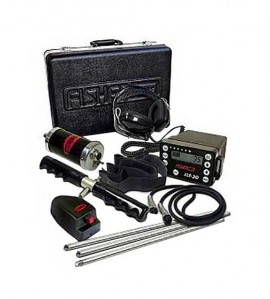
The Big Foot Sensor: Shielded Mastery for Asphalt and Outdoor Paving
The Big Foot sensor is a heavy-duty assembly enclosed in a dense, noise-dampening rubber housing. It is engineered specifically for tough outdoor environments like roadways, parking lots, and paved open grounds.
Wind and Ambient Noise Suppression: The primary failure point in outdoor acoustic locating is wind turbulence across the microphone housing. The Big Foot’s substantial weight and thick rubber shield decouple the internal transducer from wind shear and urban environmental chatter.
Optimized for Asphalt and Concrete: Because asphalt is dense, the acoustic signature of a pressurized leak spreads across a broad horizontal radius. The Big Foot’s large footprint efficiently picks up these structural vibrations without requiring invasive probe driving.
The Little Foot Sensor: Precision for Compact Spaces and Soft Soils
When surveys move off the pavement or into confined areas, the bulk of the Big Foot becomes a liability. The Little Foot sensor (and its companion probe attachments) offers compact maneuverability and direct acoustic coupling.
Soft Soil and Grass Applications: Unpaved surfaces lack the rigid structural continuity needed to transfer acoustic waves horizontally. The Little Foot configuration utilizes direct contact probe rods driven straight into soft turf, clay, or backfill soil, bypassing the dampening topsoil layer to establish direct mechanical contact near the buried utility.
Tight Corridors and Interior Slab Locating: For residential slabs, utility vaults, or crowded mechanical rooms, the Little Foot’s smaller footprint allows pinpoint placement along narrow walls, tile floors, and tight foundation corners.
Advanced Frequency Filtering: Isolating the Leak
Acoustic hardware is only half the equation. The Fisher XLT-30 features active notch filtering and variable frequency band selection (ranging from low-frequency earth-rumble tracking to high-frequency hiss isolation). When paired with the appropriate sensor:
Identify the baseline environment: Set the frequency range based on ground type—higher frequency bands for rigid concrete with the Little Foot, lower frequency bands for deep soil with the Big Foot.
Filter out constant interference: Engage the notch filter to mute persistent background hums like AC units or idling machinery.
Pinpoint the peak amplitude: Sweep the target area in a grid. The highest signal peak on the digital display, combined with clear audio clarity, marks the exact epicenter of the subsurface rupture.
In modern utility locating, guessing leads to dry holes and wasted excavation hours. Equipping field crews with the Fisher XLT-30 and knowing precisely when to deploy the Big Foot versus the Little Foot sensor ensures rapid, non-destructive leak pinpointing across any terrain.
XLT-30 and XLT-17 Liquid Leak Detectors Overview
This video provides an operational overview and practical field demonstration of the Fisher XLT series leak detectors and their specialized ground sensor attachments.