
Ground Penetrating Radar (GPR) operates on a fundamental physics trade-off: antenna center frequency dictates both depth of penetration and target resolution. High-frequency electromagnetic waves produce short wavelengths capable of resolving tiny, closely spaced subsurface targets, but they attenuate rapidly in conductive or lossy media. Lower frequencies trade away spatial detail to penetrate significantly deeper into the ground. Selecting the wrong frequency leads to unusable survey data—either blinding your scan to deeper targets or blurring shallow features into an uninterpretable haze.
The Physics: Resolution vs. Signal Attenuation
Electromagnetic wave propagation in any medium depends heavily on its relative dielectric permittivity and electrical conductivity. Higher frequencies experience greater dielectric loss and skin-depth attenuation per unit of distance, especially in moist or clay-rich soil.
Wavelength Control: Target resolution is directly governed by wavelength. As a general rule of thumb, a target must be at least one-quarter of a wavelength in size to produce a distinct reflection. Short wavelengths pinpoint thin wire mesh and shallow rebar, while longer wavelengths require larger targets (like water mains or drainage structures) to return clear hyperbolic signatures.
Signal Budget & Loss: High-frequency energy converts into heat much faster in lossy media. This restricts high-frequency systems to shallow applications, whereas lower frequencies conserve energy over longer path lengths to reach deeper strata.
High-Frequency Precision: Why 2.0 GHz Excels in Concrete
In structural concrete evaluation, high spatial resolution is essential. An antenna like the 2.0 GHz IDS GeoRadar C-thru emits ultra-short pulses to deliver millimeter-scale imaging.
Resolving Tightly Spaced Rebar: Slabs frequently house dense, multi-layered reinforcement networks and post-tension cables. The tight wavelength of a 2.0 GHz signal separates steel elements spaced only 2 to 3 inches apart, preventing adjacent hyperbolas from bleeding together.
Shallow Target Optimization: Most critical concrete features reside within the top 12 to 18 inches of a slab. A 2.0 GHz system concentrates its energy budget precisely where it is needed without wasting signal depth on deep, solid base material.
Maneuverability in Tight Spaces: Smaller antenna footprints allow operators to scan close to walls, around support columns, and across elevated decks where larger equipment cannot fit.
Mid-Frequency Balance: Why 600 MHz Rules Soil & Utilities
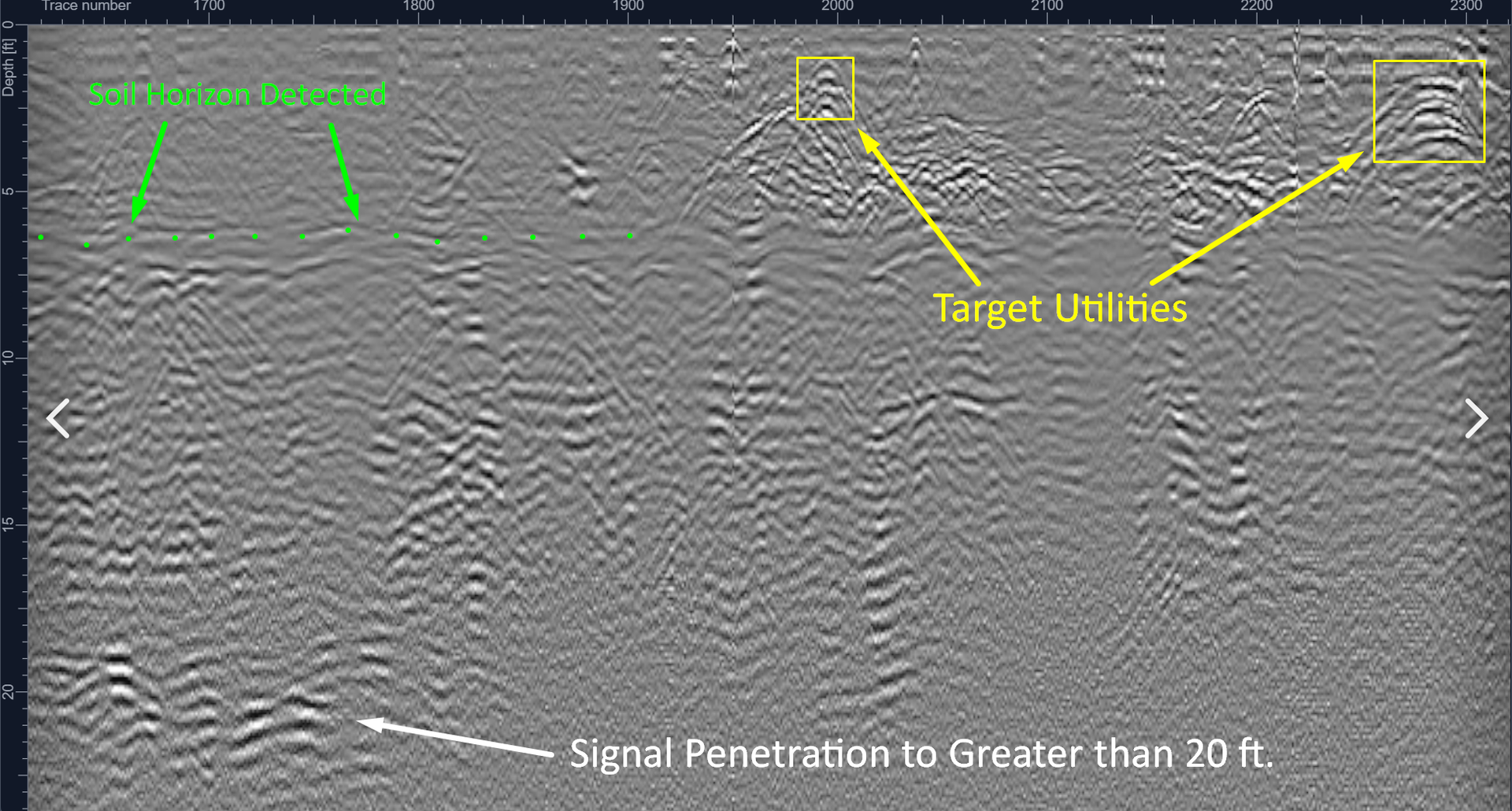
Soil is far more heterogeneous and conductive than dry structural concrete. High-frequency radar signals degrade within inches in wet clay, making mid-frequency antennas the industry standard for utility mapping and site surveys.
Ideal Depth Range: A 600 MHz antenna—such as the array powering the IDS GeoRadar Stream DP—strikes the optimal balance between depth and resolution. It reliably reaches standard utility burial depths of 6 to 10 feet across variable soil profiles.
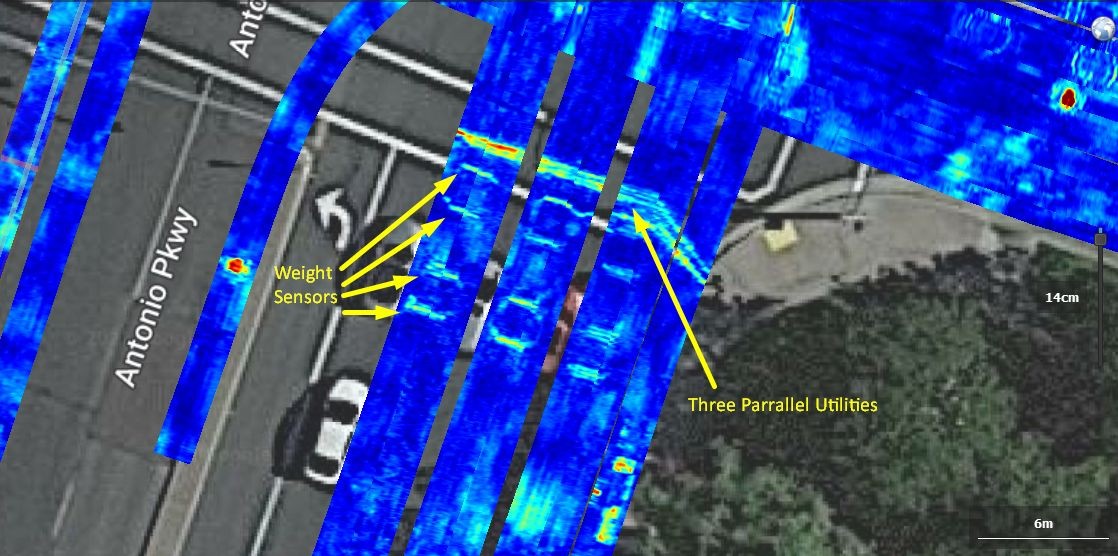
Multi-Channel Array Densification: When deployed in multi-channel configurations, 600 MHz arrays collect dense parallel profile lines in a single pass. This spatial sampling rate generates 3D tomographic models that reveal non-metallic PVC, vitrified clay, and concrete pipes that standard electromagnetic pipe locators miss.
Filtering Soil Clutter: The longer wavelength of a 600 MHz signal naturally passes through minor soil anomalies (such as small gravel or fine root systems) while reflecting clearly off true structural targets like trench walls and utility pipes.
Field Application: Matching the Antenna to the Objective
Deploying a 2.0 GHz concrete scanner over open soil yields near-zero penetration, while pushing a 600 MHz cart over a structural slab produces wavelengths too wide to distinguish individual rebar strands from conduit. At Bigman Geophysical, understanding these wave dynamics ensures we deploy the right antenna technology—whether a high-frequency handheld scanner or a multi-channel ground array—to deliver clear, actionable subsurface answers.
In this video, Dr. Daniel Bigman from Learn GPR breaks down the core physics of wave frequency, demonstrating how antenna frequency directly dictates penetration depth and target resolution during GPR data collection.