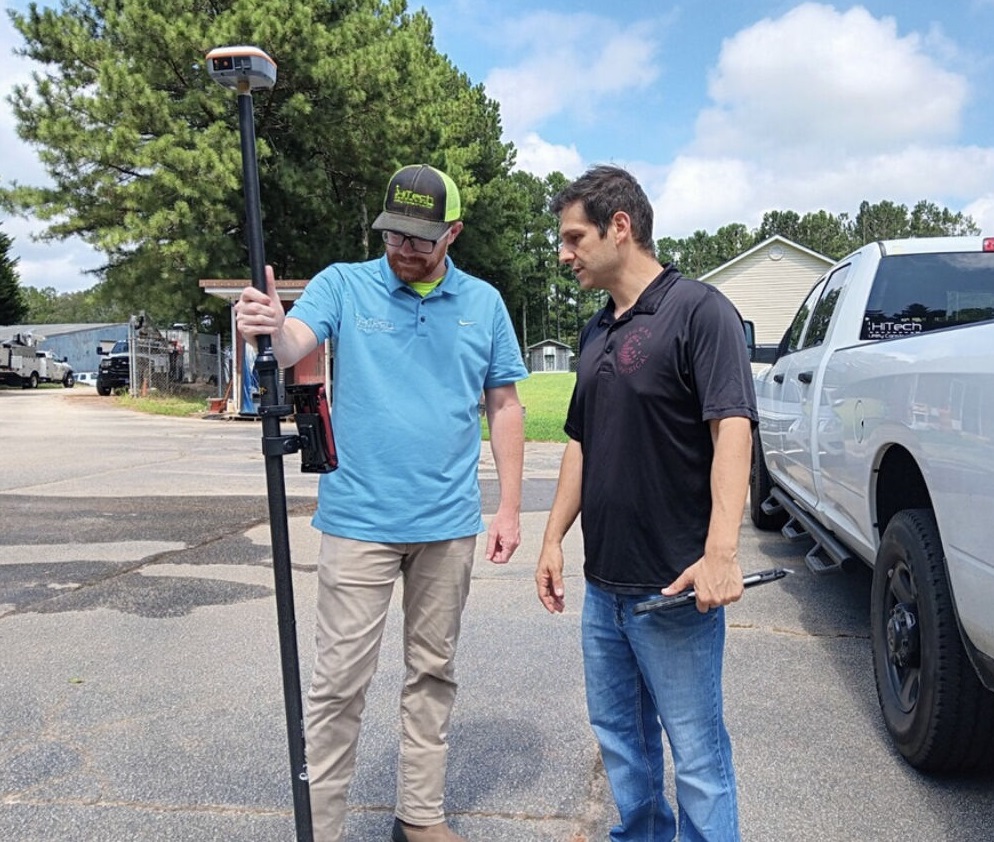
As Ground Penetrating Radar (GPR) professionals, we are often viewed as the superheroes of the subsurface world. Clients call us when they need to "see through" concrete or soil, expecting our equipment to act like an all-seeing medical X-ray.
But as any experienced operator knows, our superpowers are bound by the laws of physics.
A major dilemma in our industry occurs when a client’s expectations clash with the hard realities of radar technology. In a classic example, a cemetery management team recently reached out after accidentally disturbing an unmarked grave while excavating a new plot. They wanted a GPR survey to map out the rest of the cemetery to ensure it never happened again.
However, during contract negotiations, the client demanded a clause requiring the GPR provider to take on total liability if any unmarked graves were missed in the future.
The provider rightfully walked away from the job. Here is why saying "no" to unreasonable liability demands is sometimes the most professional move you can make.
1. The Physics of GPR: No Contrast, No Reflection
To understand why you can never guarantee 100% detection accuracy, you have to look at how GPR actually works. Radar doesn't "see" objects; it detects contrasts in the subsurface.
When a high-frequency radio wave travels through the ground, it only bounces back to the receiver if it hits a boundary between two materials with different electrical properties (specifically, relative permittivity or dielectric constants).
The Contrast Principle: If an object has the same electrical properties as the soil surrounding it, it is virtually invisible to GPR, no matter how advanced the equipment is.
2. The Case of the Disappearing Target (Soil Homogenization)
In application areas like cemetery mapping or searching for historic unmarked graves, the physical limitations of GPR become incredibly obvious over time.
When a burial occurs, the initial excavation creates a distinct "grave shaft" by disturbing the natural soil layers. If there is a wooden coffin, it creates an air pocket or a void. In the short term, these create excellent, high-contrast targets for GPR.
However, as decades or centuries pass:
Wooden coffins completely collapse and decay.
Skeletal remains degrade.
The disturbed soil in the grave shaft settles and blends perfectly back into the surrounding earth.
This process is known as soil homogenization. Once the grave contents and the surrounding soil become physically and chemically identical, the necessary contrast disappears. The physics of the universe dictate that no radar wave will reflect off that location—and no amount of operator expertise can change that.
3. Contractual Liability vs. Reality
Because GPR cannot guarantee a 100% detection rate under all soil conditions, your contracts must reflect this reality. GPR is a highly effective risk-mitigation tool, not an absolute guarantee.
When a client insists on shifting the liability of future utility strikes or missed subsurface features onto your shoulders, they are asking you to insure a risk that is fundamentally uninsurable.
If a potential client refuses to accept the standard limitations of GPR technology, it is a massive red flag. Proceeding with the project creates a zero-win scenario:
If you find everything: You get paid your standard rate.
If physics wins and a target is missed: You face potentially catastrophic legal and financial liabilities.
Knowing When to Stand Your Ground
Turning down business is never easy, especially when you want to help a client solve a sensitive problem. But part of being an elite, professional geophysicist or locator is educating your clients on what the technology can and cannot do.
If a client wants GPR to do what it simply cannot do, the healthiest path forward for your business—and your peace of mind—is to stick to your guns, protect your liability, and walk away.
Partner with the Experts Who Know the Limits
At Bigman Geophysical, we pride ourselves on accurate data, honest assessments, and top-tier training. We don't overpromise; we deliver the highest quality subsurface insights possible within the bounds of physical science.
Looking for Training? Learn how to accurately interpret complex data and navigate field limitations at LearnGPR.com.
Need Reliable Subsurface Mapping? Contact the team at Bigman Geophysical today to discuss your next project with experts who tell it to you straight.