Ever had a piece of industrial equipment just... quit? It’s never at a convenient time, and the "why" is often buried deep inside a foot of reinforced concrete. Recently, our team was called in to solve a subsurface mystery. One specific pump base (let's call it Pump C) suffered a structural failure for unknown reasons. With three other identical units on the line, the mission was clear: find the root cause and see if the other pumps were ticking time bombs.
Here is how we used a "triple threat" of non-destructive testing (NDT) to peer inside the concrete without breaking out the jackhammers.
The NDT Toolkit: Three Ways to "See" Through Reinforced Concrete
To get a full picture, we deployed three different technologies that complement each other’s strengths:
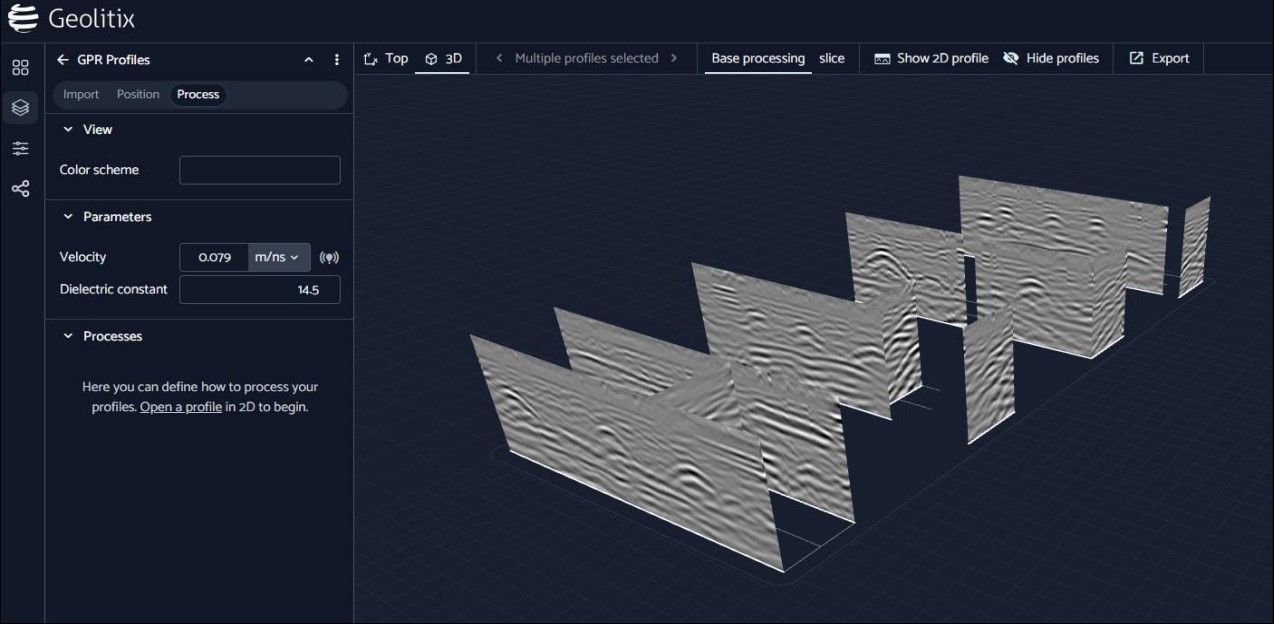
Ground-Penetrating Radar (GPR): Think of this as X-ray vision for construction. It uses electromagnetic pulses to map out rebar, conduits, and the thickness of the concrete walls.
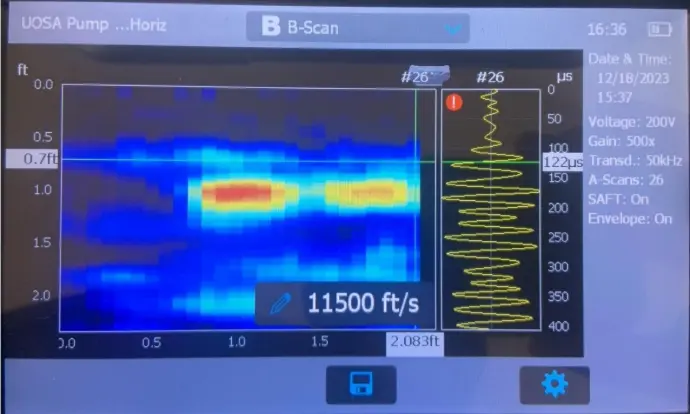
Ultrasonic Pulse Echo (UPE): This is essentially sonar for concrete. It’s particularly good at finding hidden cracks, voids (air pockets), or "honeycombing" where the concrete didn't pour correctly.
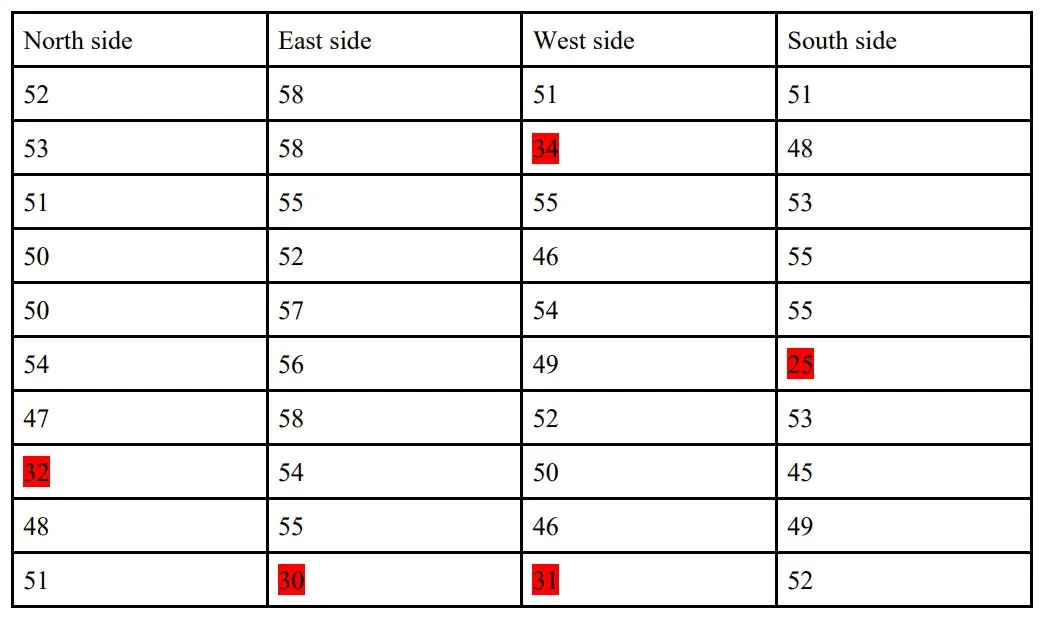
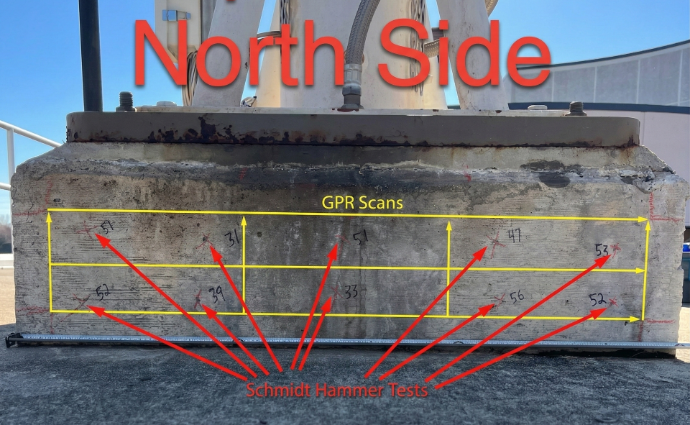
Rebound Hammer (Schmidt Hammer): A simple but effective tool that measure's the surface hardness of the concrete. It gives us a quick estimate of the material's compressive strength.
Complementary Technologies
Three separate technologies were deployed to maximize the level of information that could be learned rapidly, without downtime.
Full Computer Analysis
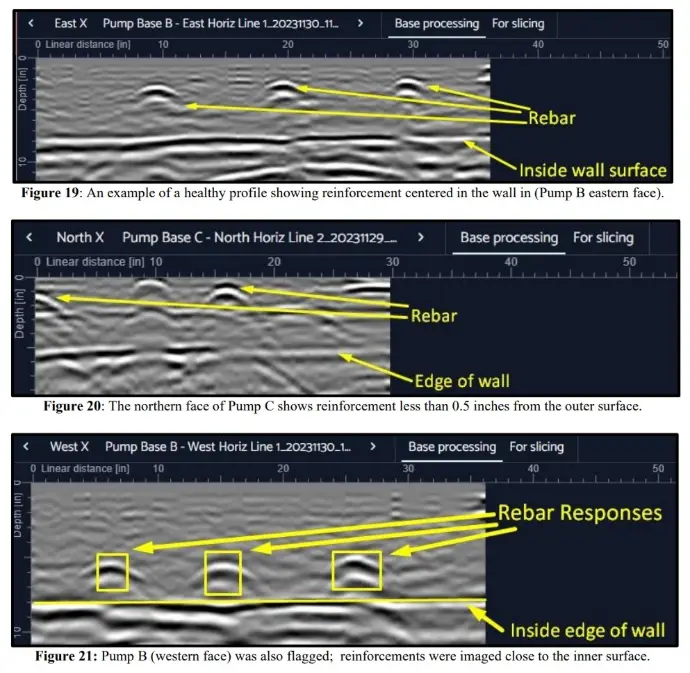
The results were reviewed by offsite specialists who compared information to as-builts and highlighted discrepancies.
Preliminary Results
Targets of concern were noted immediately during scanning showing places were operational equipment was likely to soon fail.
The Investigation: A Tale of Four Pumps
We ran bi-directional grids over the vertical faces of all four pump bases. While some results were "textbook," others were a bit more... dramatic.
| Target | The Verdict | Key Findings |
| Pump A | Healthy | Uniform concrete and perfectly centered rebar. |
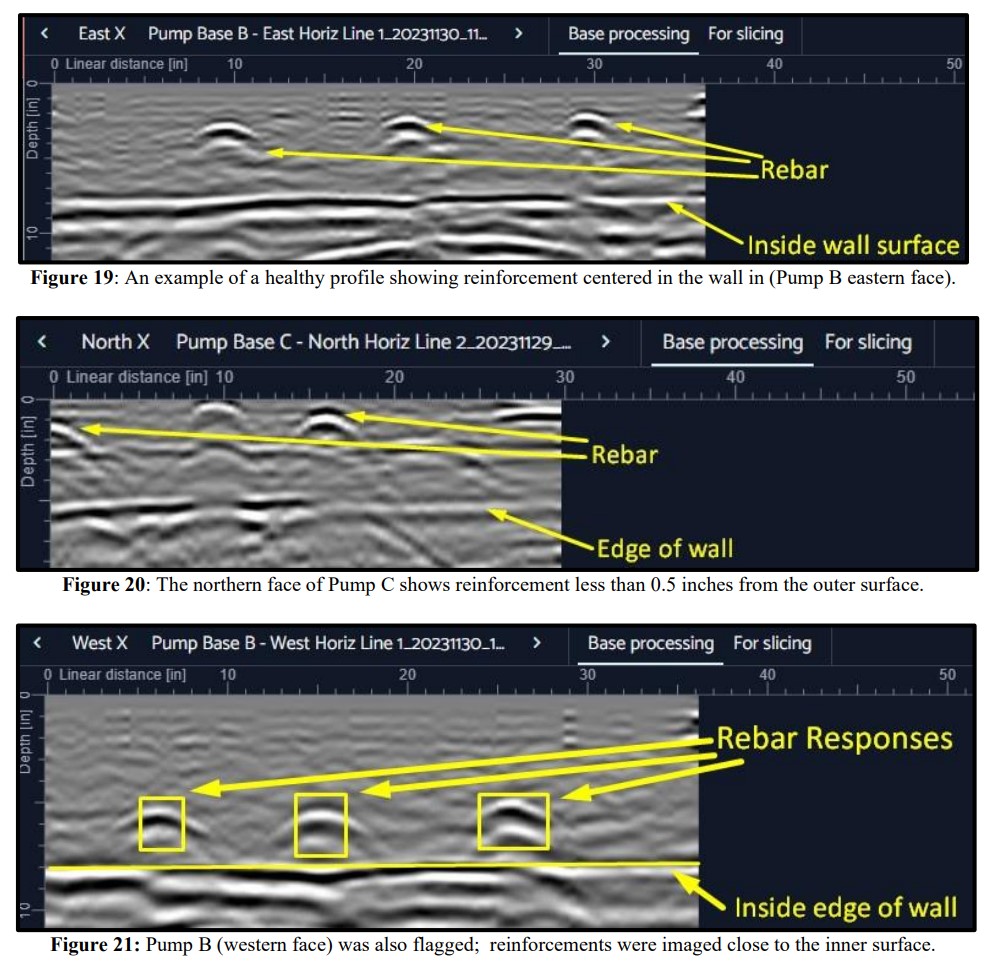
| Pump B | At Risk | Rebar was poorly centered in the western wall, sitting dangerously close to the inside edge. |
| Pump C | FAILED | Major structural red flags. Rebar had less than 0.5 inches of concrete cover on the north face. |
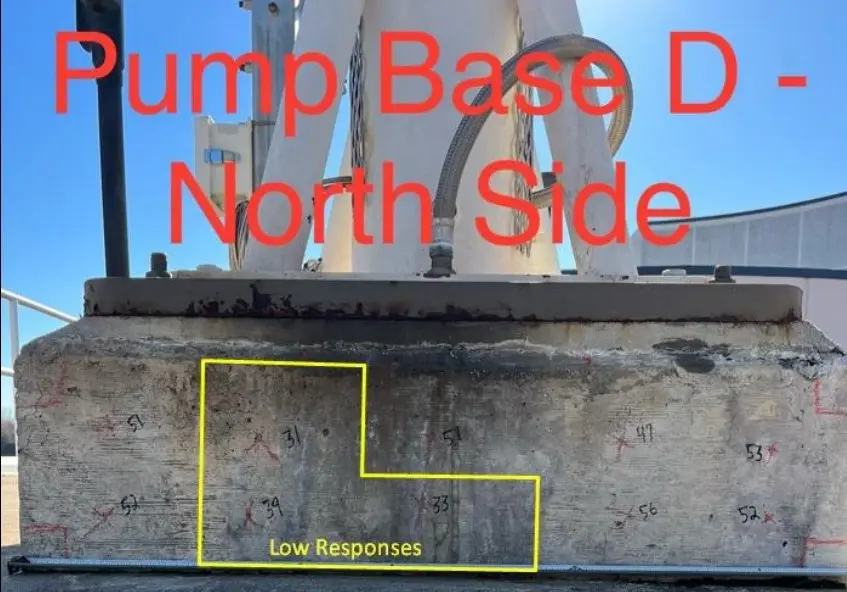
| Pump D | Concerning | Significant surface staining matched up with "clusters" of low strength readings from the rebound hammer. |
The "Smoking Gun"
So, what happened to Pump C? The GPR data revealed a critical flaw: insufficient concrete cover.
When rebar is placed too close to the surface—in this case, just half an inch—the concrete can't properly protect the steel or distribute the load. Over time, the constant vibration and weight of the pump likely caused the shallow concrete to flex and fail.
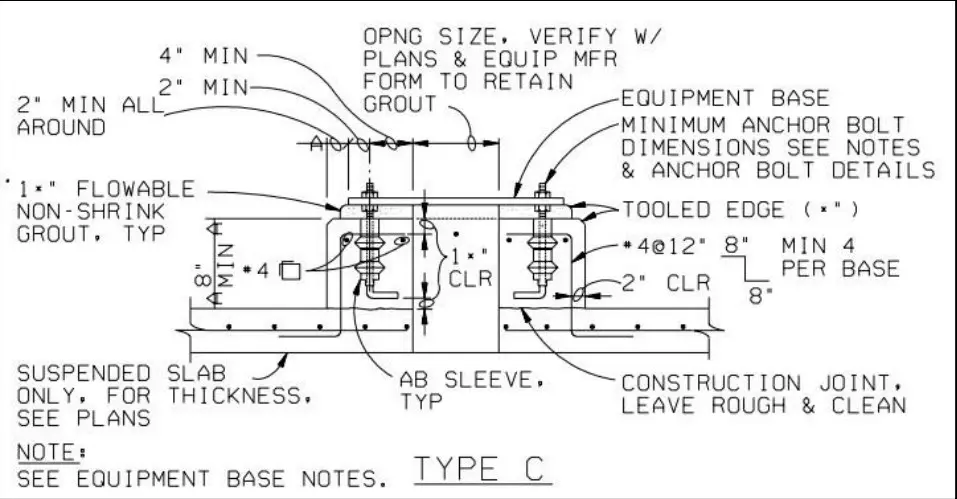
Expert Insight: Interestingly, the vertical reinforcements we found didn't match the original engineering drawings. The drawings showed deep L-bolts, but our GPR signatures suggest a shallower rebar anchoring system was used instead. That discrepancy might have been the primary cause of failure.
The Bottom Line: Trust, but Verify
This project is a perfect reminder that what’s on the blueprints isn't always what ends up in the ground. By using NDT, we were able to identify that Pump B and Pump D also show signs of weakness (poor rebar placement and potential material degradation) before they followed in Pump C's footsteps.
If you’ve got critical infrastructure that’s aging or acting up, don't wait for the crack to appear. A little bit of "X-ray vision" today can save a lot of downtime tomorrow.